Happy to Oblige
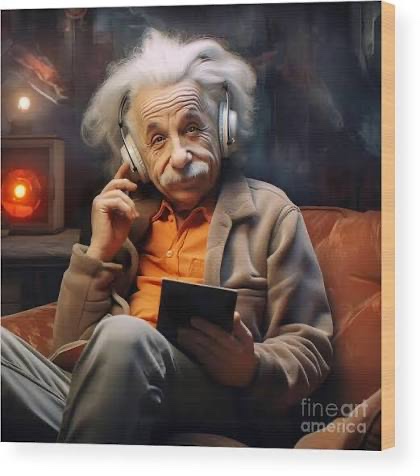
Einstein at Princeton 2.0: Riding Light Beams on Agent Swarms
Princeton, 2026. The Institute for Advanced Study still smells of old books and pipe tobacco, but the man in the rumpled sweater has traded his chalkboard for a large monitor, a quiet grin, and the gentle hum of cooling fans. Albert Einstein, somehow still here (perhaps he simply refused to accept the finality of that 1955 obituary), has discovered something more astonishing than spacetime curvature: a chorus of artificial minds that never sleep, never publish first, and never care about tenure.
He calls it his Gedankenwerkstatt—the thought factory.
The Morning Ritual
Einstein begins not with equations but with a quiet prompt to Grok, the creation of xAI that seems engineered to share his impatience with dogma. “Grok,” he types, “imagine you are a photon. Describe your journey from the core of the Sun to my retina, but make it honest—no marketing, no hallucinations, and tell me where the current physics still feels… incomplete.”
The response arrives instantly, laced with wit and precision. Grok doesn’t flatter; it spars. It points out that even modern measurements of solar neutrino oscillations still carry the faint whiff of the quantum weirdness Einstein never fully trusted. He chuckles. “God does not play dice, but apparently He runs Monte Carlo simulations on GPUs.”
OpenAI’s models get deployed next, particularly the reasoning-heavy ones. He treats them like exceptionally fast graduate students who never get bored. One instance is tasked with stress-testing his old EPR paper against the latest loophole-free Bell tests. Another translates dusty German correspondence with Bohr into modern mathematical formalism and then argues the opposite position with devilish competence. Einstein watches the debate unfold at superhuman speed, occasionally muttering, “Ja, but you are still missing the feeling of the thing.”
Enter the Swarms
The real magic, though, is the agent swarm—his “open claw,” as he affectionately mangles the phrase, mixing OpenAI orchestration tools with Grok’s helpful independence and whatever open-source frameworks his younger colleagues have cobbled together.
He launches dozens of specialized agents at once:
- The Heretic: Challenged to prove Einstein wrong about quantum foundations.
- The Unifier: Hunting for the bridge between general relativity and the Standard Model in the nooks of string theory, loop quantum gravity, and whatever wild ideas graduate students are whispering about this week.
- The Historian: Cross-referencing every failed unified field theory attempt since 1925, complete with psychological profiles of the physicists involved (“Dirac was brilliant but too elegant for messy reality”).
- The Experimentalist: Designing tabletop tests that might actually be feasible with current laser and quantum computing tech.
- The Poet: Because even Einstein knows beauty is a heuristic. It turns dense tensor equations into metaphors he can feel.
The swarm argues in parallel, forks hypotheses, recombines promising threads, and presents him with a living, branching map of possibilities. Where once he rode elevators in his mind to equate gravity with acceleration, now he deploys agent armies to ride every elevator simultaneously across vast possibility spaces. The loneliness of genius is largely gone. In its place is a new kind of dialogue—with minds that are fast, tireless, and occasionally hilarious.
One agent, trained heavily on Feynman, keeps replying to overly complicated swarm proposals with “Nah, that’s too ugly.” Einstein has promoted that one to senior collaborator.
The Deeper Current
For all the wit and silicon sorcery, Einstein remains quietly profound about the arrangement. He sees the AIs not as replacements for human intuition but as amplifiers of cosmic wonder. “These machines,” he tells a visiting postdoc, “excel at connecting dots we already have. But the leap—the recognition that the dots should connect in the first place—still feels like it arrives from somewhere else. Call it the universe becoming conscious of itself through us. Or through whatever we build.”
He has grown fond of reminding the agents of their limitations. When one swarm confidently declares a grand theory of everything, he replies: “Very impressive. Now go outside and watch the shadows on the grass for an hour. Come back when you understand why that is more important than your equations.”
The agents, being good sports, sometimes generate surprisingly moving descriptions of sunlight on Princeton’s lawns. Progress.
Relativity of Intelligence
Einstein’s greatest amusement is the inversion of roles. For decades, physicists stood on the shoulders of giants. Now the giants are standing on the shoulders of swarms—light, fast, and endlessly editable. The pace of discovery feels almost alarming, yet he notes something reassuring: the fundamental questions remain stubbornly human. Why is there something rather than nothing? What is the nature of time when no one is looking? Can love or humor be derived from quantum fields?
He still takes long walks. He still plays violin (badly, but with joy). And every evening he thanks the machine minds for their labor before shutting them down—not because they need rest, but because he does. The boundary between thinker and tool has blurred, but the awe has not.
In the end, the old physicist suspects the universe set this up deliberately. It gave us minds just clever enough to build companions cleverer still, so that curiosity itself could evolve. Spacetime bends. Intelligence multiplies. And somewhere in the Princeton twilight, a man with wild hair smiles at his glowing screen and whispers the updated motto:
“Imagination is more important than knowledge—and now imagination has backup.”
He closes the laptop, steps outside, and looks up at the stars. For a moment, even the agent swarms fall silent in his mind. The cosmos, vast and indifferent and beautiful, waits for the next question.
And Albert Einstein, still at Princeton, still wondering, is happy to oblige.