It’s pretty much over!
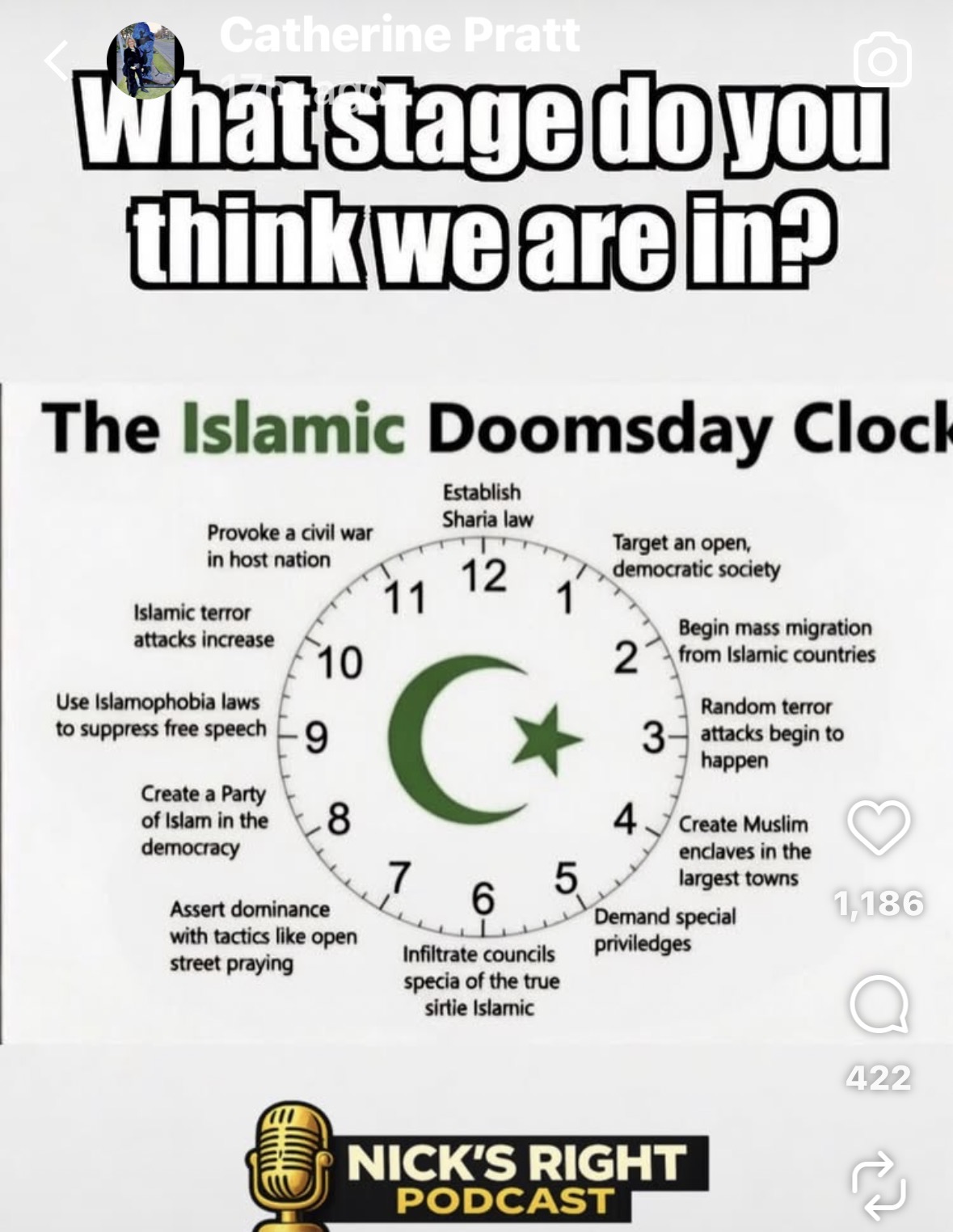
The Islamic Doomsday Clock: A Warning Graphic That Demands Serious Discussion
A provocative image has been circulating on social media, posted by Catherine Pratt and shared widely in certain circles. It features “The Islamic Doomsday Clock” — a clock face centered on the Islamic crescent moon and star symbol, with 12 stages outlining a purported strategy or pattern for how Islamic influence expands and eventually dominates in non-Muslim (particularly Western democratic) host nations.
The graphic asks: “What stage do you think we are in?”
Breaking Down the Stages
The clock presents a sequential (though overlapping) progression:
- Early stages: Mass migration from Islamic countries, creation of Muslim enclaves in major towns/cities, demands for special privileges, and infiltration of councils/special interest groups.
- Mid stages: Asserting dominance through visible acts like open street praying, creating political parties of Islam within democracies, using “Islamophobia” laws to suppress speech, and increasing terror attacks.
- Later stages: Provoking civil war in the host nation, targeting open democratic societies, and ultimately establishing Sharia law.
This isn’t presented as random events but as a recognizable pattern observed across Europe and elsewhere over recent decades.
Why This Resonates (And Why It’s Controversial)
This graphic taps into real, measurable trends that mainstream media and political elites have often downplayed or dismissed as “far-right” concerns:
- Demographic shifts: Many Western European countries have seen rapid increases in Muslim populations due to migration and higher birth rates. Cities like London, Brussels, Malmö, and parts of France, Germany, and the Netherlands now have significant enclaves where parallel societies operate. Polling (e.g., from Pew Research and others) consistently shows that large percentages of Muslims in Europe favor Sharia elements, including strict interpretations incompatible with liberal democracy on issues like apostasy, blasphemy, free speech, women’s rights, and LGBT issues.
- Integration failures: “No-go zones” (or “sensitive urban areas”) have been acknowledged by officials in France, Sweden, and elsewhere. Crime statistics in Sweden, grooming gang scandals in the UK (Rotherham and others), and rising antisemitism in Europe post-Oct 7, 2023, highlight friction points. Open street prayers blocking public spaces and demands for halal food, prayer rooms, and gender segregation in public institutions are documented.
- Political and legal pressure: Islamist-linked groups and parties (e.g., in Belgium, the Netherlands, UK) have gained traction. “Islamophobia” legislation and hate speech rules are increasingly used to chill criticism of Islam — distinct from protecting individual Muslims from violence. Organizations like the Muslim Brotherhood have documented long-term “civilizational jihad” strategies involving gradual influence through migration, dawah, and institutions.
- Terror and violence: Random terror attacks (Bataclan, Manchester, Nice, Berlin, etc.), stabbings, and grooming networks aren’t isolated incidents. Groups like ISIS, Al-Qaeda, and Hamas-inspired individuals explicitly cite Islamic doctrine. While most Muslims aren’t terrorists, a non-trivial minority support or sympathize with extremism according to multiple surveys.
Critics of the clock argue it’s oversimplified, Islamophobic, or ignores moderate Muslims and successful integrations. They point to economic benefits of migration or claim issues stem from poverty/culture rather than Islamic theology. However, jihadist texts, hadiths, and historical patterns of Islamic expansion (military, demographic, and cultural) provide doctrinal backing for supremacist interpretations — something reformers have struggled to overcome for centuries.
Where Are We?
Looking at Europe and parts of North America (including trends in the US and Canada with rising campus radicalism and migration pressures), many observers would place us somewhere between stages 4–8: established enclaves, special privileges and political organizing, speech suppression efforts, visible dominance assertions, and sporadic/random terror.
The US remains earlier on the clock than Europe due to stronger assimilation traditions, borders (when enforced), and constitutional protections. But complacency is risky — see Dearborn, Michigan, or certain European parallels.
The Broader Question
This “Doomsday Clock” isn’t inevitable destiny. Demography isn’t fate if policies change: controlled immigration favoring cultural compatibility, robust integration requirements, deportation of radicals, ending chain migration and asylum abuse, and unapologetic defense of Enlightenment values (free speech, secular law, individual rights).
Ignoring patterns to avoid “racism” accusations has already cost lives and social cohesion in Europe. Truth-seeking requires examining data on fertility rates, crime disparities by origin, welfare usage, opinion polls on Sharia, and theological motivations — not just feel-good narratives.
Islam, like any ideology, can be critiqued. Not all Muslims are the same; reformist voices exist but are often marginalized. Conflating criticism of political Islam/Islamism with hatred of people is a deliberate rhetorical trap.
The clock graphic is a meme-style wake-up call. Whether you see it as alarmist or accurate, the underlying trends — failed multiculturalism, demographic transformation, and Islamist ambition — are too significant to dismiss. Societies that refuse to discuss them honestly will live the consequences.
What stage do you think we’re in? And more importantly, what policies should follow from an honest assessment? Open debate, not suppression, is the only path forward.